
Design & Build · 7 min read
Anatomy of a Custom Motor Yacht: Composite Hull to Flybridge Helm
How a bespoke motor yacht is resolved from the keel up: composite layup, twin propulsion, a flybridge built around its helmsman and a master stateroom that stays quiet underway.
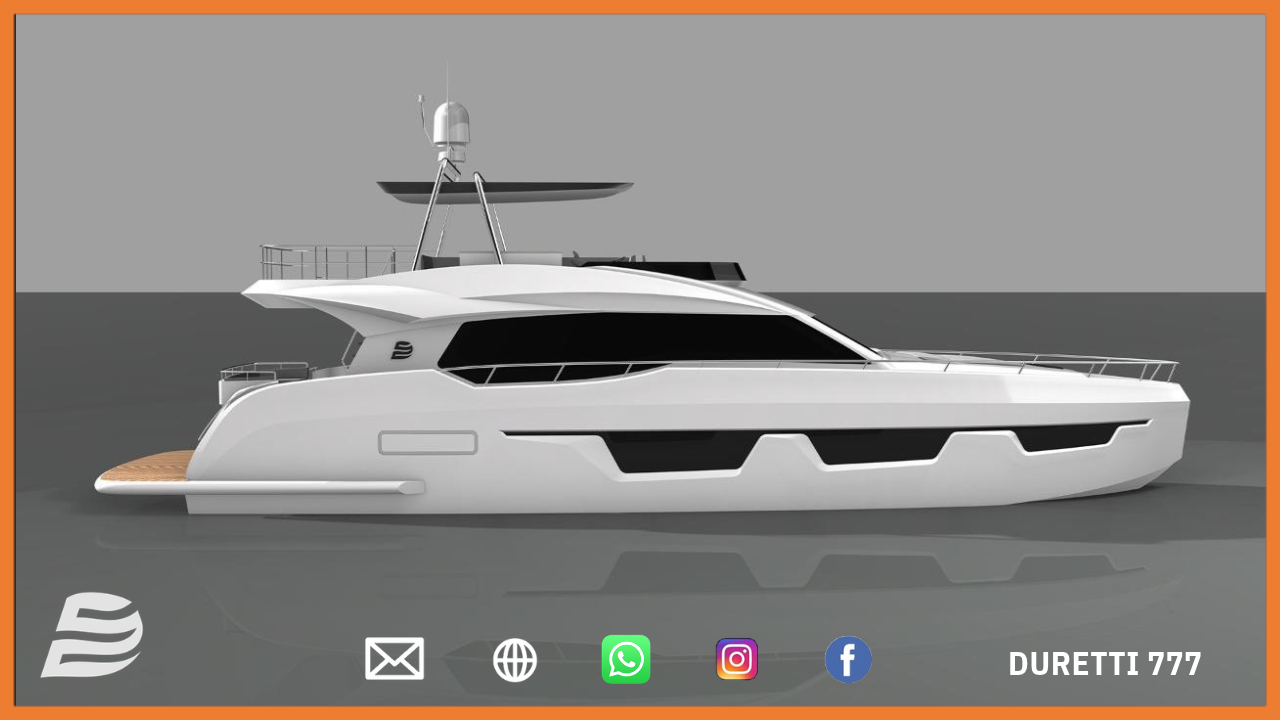
A custom yacht is not assembled from catalogue parts. It is resolved, decision by decision, from the keel up, and every early choice constrains the next. DURETTI builds on Belgian and German marine engineering standards, shaped by European design, and delivers from shipyards in Umm Al Quwain and Abu Dhabi. This guide walks through four places where that thinking shows.
Use the stage below to explore the vessel. Drag to rotate, scroll or pinch to zoom, and select a numbered pin to move in on a specific feature and read the detail behind it.
Start with the laminate
Hull construction sets the character of a yacht for decades. A modern composite hull is a sandwich: outer and inner skins of glass laminate either side of a lightweight foam core. The skins carry the loads, the core keeps them apart, and stiffness rises sharply without a matching rise in weight. A stiffer, lighter hull slams less, flexes less and uses less fuel at the same speed.
Process matters as much as materials. Vacuum-assisted infusion draws resin through the dry reinforcement under controlled pressure, which gives a consistent resin-to-glass ratio and fewer voids than hand laying alone. Consistency is what a long hull warranty rests on, and it is why DURETTI stands behind its hulls for ten years.
Two shafts, one philosophy
Twin propulsion is chosen for resilience as much as performance. With two engines, a fault does not end the passage, and at the dock the owner can walk the boat sideways with the throttles. Less visible is the geometry: engine-bed height, shaft angle and propeller tip clearance all depend on hull shape, so the propulsion layout is drawn alongside the hull lines.
The same principle runs through the superstructure. The flybridge is positioned for sightlines first and for appearance second. A helm that lets the captain see the bow, both quarters and the dock edge reduces stress, and calm captains make safer passages.
Good yacht design is mostly invisible: the quiet cabin, the clear view from the helm, the hull that does not complain in a chop.
Below, the master stateroom is placed away from engine noise and insulated for both sound and heat. In the tropics the air-conditioning plant is part of the structure of the experience: specified generously, ducted quietly, and tied to the vessel's electrical capacity from the first drawing.
If you are considering a commission, tell us how you will use the vessel: where you will cruise, who will be aboard and who will drive. Those answers shape every decision above.
An illustrative engineering overview. Specifications, materials and layouts are confirmed per commission with the DURETTI team.
Commission / technical inquiry
Tell us about your vessel.
Share a size, a use and a cruising ground. Our team will reply with considered options, not a brochure.